
La Salle Bacolod started and the Founding Brothers made sure that a library was available to meet the needs of the academic community. The present Lower Grade Library of the Integrated School is in the same location as the first library.
ABOUT US
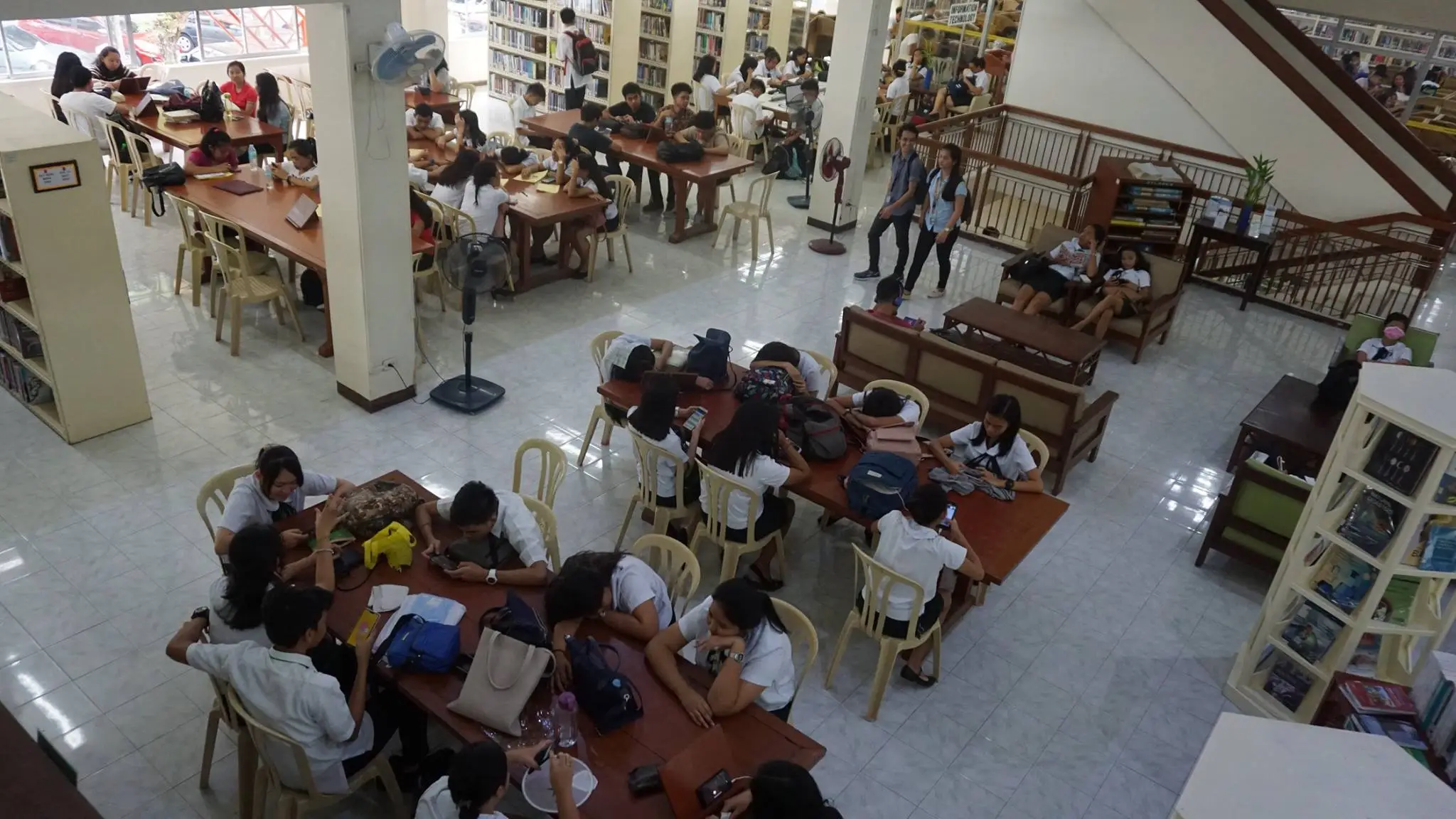
THE HEU LEARNING RESOURCE CENTER (HEU LRC)
The HEU Learning Resource Center, named for its benefactor Don Alfred Montelibano Sr., AFSC, is composed of the College Library, which is situated in the middle of the college buildings; the Professional School libraries, which include the Graduate School library in the Solomon building; the Colleges of Medicine and Law libraries, which are located on the ground floor and third floor of the Professional Schools Building, respectively; and the Instructional Media Center (IMC), which is located on the ground floor of the Cody Building. The Library is a collection of information sources such as books, periodicals, online resources like ProQuest, EbscoHost, ScienceDirect, Wiley Online Library, Philippine E-Journal, elibraryUSA, and multimedia materials. It provides excellent resources, innovative services, and collaborative learning spaces to support the teaching and research needs of the academic community.
OUR HISTORY
1952
1953
When the High School and College Departments opened, a room in the High School Department was assigned as the High School and College Library.
1958
The Boarding Department was converted into a Science Laboratory and the College Library was relocated to the ground floor, where it remained for the next twenty-five years.
1982–1983
Through the efforts of Brother President Rafael S. Donato FSC, a new library complex was built to accommodate the increasing library clientele and collection. It was completed and occupied in April 1983 with 13,000 volumes of books.
1995–1996
In February 1995, the JRR Dizon Foundation Library Technology introduced the INTERNET. In June 1996, the center provided the College of Engineering, Computer Center, and some offices of the College with Internet services.
1997
On October 19, the library occupied the ground floor and was renamed the 3-story building Alfredo M. Montelibano, Sr., AFSC Library in honor of the benefactor who donated the land where the University of St. La Salle campus now stands.
1998
The library spearheaded extension programs giving access to offices of the college unit. Networking was implemented in cooperation with ICEN to enable direct access to student records from the Registrar's Office.
1999–2001
Construction of the Graduate School, College of Law, and Medical Library Building started. The libraries were blessed on October 31, 1999. The College of Law Library was awarded as the Model Centennial Law Library on June 8, 2001 by the Supreme Court of the Philippines.
2002
The Health Science Library (now the Medical Library) occupied the 3rd floor of the Professional School Library building along with a Multi-Media Room for the use of the College of Medicine.
2012
The Archives was blessed and named Lasalliana University Archives, serving as the repository of the historical records of the University of St. La Salle.
2016
The Audio-Visual Resource Center was merged with the College Library and renamed the Learning Resource Center (LRC). In the same year, the Lasalliana University Archives were transferred to Museo De La Salle Bacolod.
TODAY
Don Alfredo M. Montelibano Sr., AFSC Learning Resource Center (LRC) continues to uphold its mission and vision with excellence in serving the academic community and our society.
MISSION
The HEU Learning Resource Center (LRC) is committed to providing access to high-quality educational resources, innovative services, and a better learning environment that supports the academic and research needs of the University community.
VISION
The HEU Learning Resource Center (LRC) aspires to be a pro-active learning hub with excellent resources, state-of-the-art technology, and innovative services that empower students, faculty, and researchers to achieve academic excellence and contribute to knowledge creation and dissemination.